
Alas (lyrics of a song to the tune Greensleeves)
Pentecost 14; Jeremiah 4:11-12, 22-28; 1 Timothy 1:1-2, 12-19a; Luke 15:1-10
Alas, O God, we do you wrong
to cast you off discourteously,
for you have loved our world so long,
delighting in our company.
Mend, mend our disgraceful ways,
vain displays of fame and wealth.
Bend, bend our reluctant knees
to touch the hurt Earth and seek health.

See how the powers of evil grow
and good is lost where greed holds sway.
The Earth is bare, the birds have fled
and foolish people go astray.
Here, here we forget to pray
Wisdom’s guide we sorely lack.
Where, where is the One who cares,
who sees that the lost are brought back?

Paul tells of how he changed his ways
from violent acts of unbelief.
His gratitude to Jesus shows
how faith and love brought him relief.
Grace, grace of the Lord is here;
turn us round and make us strong!
Peace, peace of the Lord we need
to soften our hearts to mend wrong.

The shepherd who retrieves the lost
will call his friends to celebrate.
The woman searches carefully
and finds her lost coin. Her joy is great.
Sing, sing with the angel choirs;
souls return who went astray!
Bring, bring us to that resolve
where care and respect bring new day.
	Barbara Messner 11/09/2025
Shanay in Sunshine
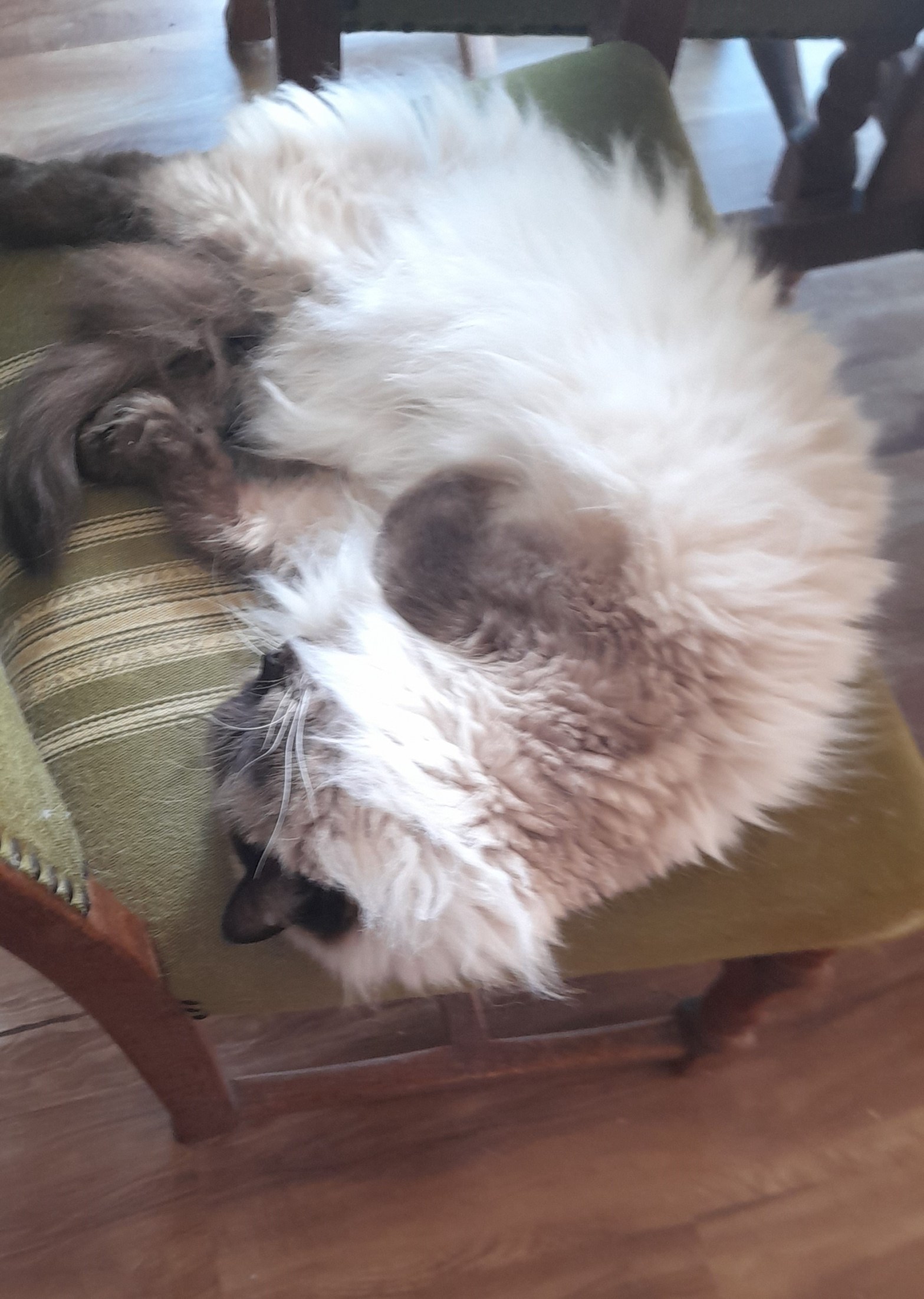
We are grieving the death
of our little cat Shanay.

It seems as if
the sun won’t shine
without her invoking its presence
as she gazes at the sky
from the chair by the glass door.
How she luxuriated in its warmth
when the sunshine obliged her:
praise and gratitude personified!

How can I read
with the same delight
propped up on the couch
without the tread of small paws
over my shoulder
and a warm light weight
settling on my chest
waving a tail in my face
and turning to rub her nose on mine,
her small body generous with purring
as if her whole being vibrated with love?

She came to us already ageing
and gave us three years
of her gentle affectionate presence.
Thank you, loving God, for Shanay.
May she rest in your warmth and light. Amen.
Places of Honour

Places of Honour
Pentecost 12; Luke 14:1, 7-14
Jesus was invited to a sabbath meal
at the home of a leader of the Pharisees,
and he noted how some people chose
the places nearest their host
as though they were entitled
to be seen to be important
because of prestige or pedigree.
Then he told them a parable
that exposed the absurdity
of displays of superiority.

He turned the tables as it were
on their practices of honour and shame,
and suggested a counter-cultural banquet
where only the humble were invited,
those who were poor or disabled,
those who could not return the invitation.

I wonder how this parable
might apply to me, unwilling
to attend or to host a banquet,
and unsuited to climb ladders,
either physical or hierarchical.

Too easy though to cop out:
although I don’t aspire
to choose or to be assigned
institutional places of honour,
I have to admit that I love
to be out front in worship,
to deploy my performance skills
and my years of study and reflection,
to declaim the words of thanksgiving,
to consecrate and administer
the sacramental bread and wine
to those who gather at the table.
Do I not occupy a place of honour there?

Am I guilty of exalting myself?
I have observed some who do.
Is it sufficiently humble
to ask the hard questions?
Where is the fine line
between entitlement
and empowerment?
Are my gifts and presence
used in the service of the Spirit,
or co-opted for inflation of my ego
and manipulation of others?
If we were to hold a banquet
for the poor and marginalized,
would they feel patronized
by our display of generosity?
Is it possible to foster a meeting
of sharing and mutual respect
where all are genuinely humble,
willing to learn from each other?

I love that saying
that Christ in me
meets Christ in the other.
Perhaps the heavenly banquet
revolves around the host at centre,
the welcomer between and within,
and all are hosts and honoured guests.
	Barbara Messner 28/08/2025
A Spirit that Cripples

A  Spirit that Cripples
Pentecost 11; Luke 13:10-17
She still came there for worship although so bowed down:
“Bound by Satan!” they whispered through eighteen long years,
Her bent back was a symbol of burdens she bore,
the rules which gave women no voice for their tears.

Her staunch faith was not vanquished by what pulled her down,
though she’d given up hoping that someone would see,
but Jesus had eyes that were drawn to her pain
and his was a mission to set others free.

So that woman stood straight and gave voice to her praise,
though they said that in worship no woman may speak,
and they claimed on the Sabbath nobody should heal,
but both Jesus and woman refused to be meek.

Many women through long years have felt as though bent
in places of worship where all should stand straight.
Where all should be valued, their gifts were ignored:
they knew God was calling but men made them wait.

They could clean, arrange flowers, wash linen, wash up;
they might study the Scriptures, but not dare to preach;
some could set up the altar, but not consecrate
and with women and children perhaps they might teach.

But a spirit that cripples is never from God
and no gender or colour negates Jesus’ call.
It’s not Satan that binds but abuses of power
and the arrogant ones are most likely to fall.

Jesus answered the leaders and put them to shame
but their anger would fester and lead to the cross.
Where one crowd is rejoicing, one person set free,
there is hope resurrection is worth cruel loss.
	Barbara Messner 21/08/2025
Fire and Division

Fire and Division
Pentecost 10; Luke 12:49-59
He came to bring fire to the Earth,
fire that cleanses and refines,
fire that warms and enlivens.
He wished it was already kindled
while he could shelter the flame,
guide it to make light, bake bread,
separate pure metal from dross.

Then he felt the dark and cold
closing in on him, and he knew
the spark would only ignite
when he was struck down,
and had waited entombed
like a banked hearth fire
for the stirring at dawn
to uncover the embers
and blow them into flame.

Such is the nature of fire,
sometimes smouldering unseen
in the heart of a blackened stump
or carried as a spark on the wind.
Released among dead growth,
it flares to raging power
not to be contained or tamed.

His heart aches for the conflicts
ignited by mis-used Spirit fire,
neighbours and families divided,
excuses made for crusades
and colonization, supposedly
promoting the cross, but prolonging
the agony of God’s beloved, strung up
naked outside the walls. forgiving
ignorance with tortured breaths.

Like us, they did not know
how to interpret the present time:
for them, the imminent fall
of temple and city
to the cohorts of Empire,
for us, climate change
and pandemics, wars
and environmental disasters.

Like us, they did not judge for themselves
what is right, but relied on law
that was far from impartial,
with judges appointed to shore up power,
and corrupt or self-serving authorities.

Jesus lamented then and now
that he has not come to bring peace to the Earth.
Pray that his fire of renewal be already kindled:
the cleansing fire of justice for the oppressed,
the warming heart fire of compassion.
	Barbara Messner 13/08/2025
My Treasures

My Treasures
Pentecost 9; Luke 12:32-40
Jesus says:
“Where your treasure is,
there your heart will be also.”
Where now are my treasures
that draw my heart like magnets?

I treasure the scribbling
of words on a page,
trying to touch a truth,
then sharing those words with others.
I find treasure in stories,
read, heard and told,
stories lived and imagined,
shaped and revisited
by words old and new.
Such words are treasures,
though some say enlightenment comes
from wordless contemplation.

There is treasure here for me also
in this small retirement house,
built with the last of our savings,
shaped by our son’s design.
It’s a treasured shelter
for us in our ageing,
and for our unpartnered son
who, like so many others,
can’t yet afford a place of his own.
We muddle along willingly together
through the challenges of life and relationships.
Yet Jesus says:
“Sell your possessions and give alms.”
Are shared possessions a form of alms?

There is treasure in the garden,
native bushes I have planted
and long to see mature and flower
to feed the birds and bees.
Between them, yellow soursob flowers
gather the scanty winter sun
and lift my drooping spirits with brightness,
though no doubt they are weeds,
and our garden unkempt.

There is treasure in a little cat
who comes to rest on my chest
as I lie on the couch reading stories.
She rubs her nose on mine.
We comfort each other –
as I stroke her cotton wool fur,
she purs her appreciation
and reaches a gentle paw
to touch my hand.
If she is my possession,
then I am hers as well.
Her precarious health relies on medication
and both of us are old.
No doubt in time we will fail,
though no thief comes near
and no moth destroys.
Though I fear her loss,
and hope I last to care for her,
I do not begrudge
investing my heart in hers.

Jesus says:
“Do not be afraid, little flock,
for it is your Father’s pleasure
to give you the kingdom.”
Did he not also say
that the kingdom has come near?

Sacrifice of thanksgiving I bring,
though I cannot deny my heart
is drawn to these treasures,
these gifts and possessions.
If my response is love and gratitude,
is that also treasure in heaven?
	Barbara Messner 7/08/2025
There’s another cat in our household, but that is more of a master/servant relationship – guess who is the master? I provide food and water, clean up her eccentric toileting, and provide entertainment by turning on the bath, preferably daily, for her to watch the water run in and later reach down and sip. I am reminded several times when she considers it food or bath time. Her main display of affection is when I am anchored in place on the toilet!
Take Care

Take Care
(can be sung to the tune Sally Gardens, Irish traditional, used in the Iona song Inspired by Love and Anger in Heaven Shall Not Wait (Iona Community 1987) pp.124,125, also Together in Song (HarperCollinsReligious no.674)
Pentecost 8; Luke 12:13-21
Take care! Be on your guard, friends,
against all forms of greed!
Why try to claim possessions
far more than what you need?
The rich store up abundance
to squander lavishly,
but when their life is over,
their souls will bankrupt be.

Relax, eat, drink, be merry –
sometimes, not life-time’s goal!
A life filled with indulgence
will empty out the soul.
Then when this life is over,
what treasure will be left?
If greed spends all the harvest,
what hope for those bereft?

When lifestyle makes us greedy,
we are not spirit rich.
So much of on-line buying
is just expensive kitsch.
Buy wisely for the Earth’s health
and give to those in need.
Such choices have more meaning
than any rote-said creed.
	Barbara Messner 31/07/2025
Ask, Search, Knock

Ask, Search, Knock
Pentecost 7; Luke 11:1-13
Ask and it will be given you!
While I was still a child,
I was drawn to words,
music and performance,
so, as a young woman,
I asked to be a singer,
and that was given to me,
but there’s another saying:
Be careful what you wish for,
 you might get it.

The door to singing
opened into loving,
both the ill-starred kind
that closed my throat
with tension and tears,
and the kinder kind that led
to marriage and motherhood,
a door that opened unexpectedly,
though I don’t remember knocking,
and a door that closed gradually
on the would-be singer.

Having found the gift
had been overtaken by life,
I began a search
for the meaning of me,
beginning with words
both studied and written.
I found the living Word
and a door opened in me
through which I heard a voice calling.
I began to write poetry once more
and journeyed further into Scripture
which seemed a rainbow arch
that promised a pot of God,
although always moving onward
as my search drew nearer.

I found and went on finding
that neither the meaning
of God or of me
is contained in any pot,
nor can be pinned down
any more than the rainbow,
which forms when the light
is refracted by raindrops,
or in the case of God
by the rays of insight
passing through clouds
into awe-filled sight.

Knock and the door will be opened!”
And so it was,
although sometimes doors opened
for a period of time,
and closed gently behind me
when the room became cramped,
or I had worn out
my inner welcome.
I went through what opened
and didn’t look back.
Once I heard God say,
in that small amused voice:
“I call in the opening
and closing of doors.”

Sometimes it’s a matter of timing –
the front door that was closed
swings open at last
if the knocking persists.
Thus, a door finally opened
and I stepped into the priesthood,
late and with some reluctance
on both sides.

There at last I find
the evolving meaning of me and God.
Singer and wordsmith are reborn
not into churchiness personified,
not in the mould
I was formation-ed to fill,
but in the coming together
of the parts of me,
opening into what I become
in the rainbow light of God
which is multi-hued and elusive,
appearing at times through clouds
or beyond an opening door
when I ask, search, knock.
	Barbara Messner 23/07/2025
For Those Who Sometimes Feel like Martha
For Those Who Sometimes Feel like Martha
Pentecost 6; Luke 10:38-42
He said that Mary chose the better part
but not because she sat to contemplate.
She’d acted on the promptings of her heart
despite the voices that would remonstrate.
But Martha felt she had no power of choice,
constrained by what they said was woman’s role.
At least with Jesus she could raise her voice,
believing he would help her to be whole.

Like Martha, women may feel sore at heart.
when left to cope with all the chores alone.
“If all are equal, let all do their part!”
we growl, and chew on our resentment’s bone.
Then Jesus says: “By duties you feel bound
and fear self-blame for what remains undone.
Discern real need; let other ways be found.
Too many things distract; you need but one.

At one with me, you’ll be at one with you.
Then open-hearted work will not demean
and service need not be a choice you rue.
Sit still or act in peace that will be seen.
From contemplation, you’ll know how to act.
From following, you’ll find your way to lead.
You’ll value meaning more than so-called fact
and let the truth of me in you be freed.

Then you will share with me the risen life
and learn to live the love my words reveal.
Let child or elder, woman, man or wife
receive respect as hurtful habits heal.
Let everyone of every place and race
be safe from cruel injustice that defeats.
Then freedom lies within, if you make space
by letting go of ego that competes.”
Barbara Messner 6/07/2025
A Tale to Open Ears

A Tale to Open Ears (written during NAIDOC week which celebrates indigenous history, culture and achievement)
Pentecost 5; Luke 10:25-37
We may not share their long historic spite;
now “good” Samaritan’s a common term,
but Jesus’ listeners thought the opposite.
Religious difference spurred each side’s disdain.

“Samaritans praise God on mountain top,
the Jews in temple at Jerusalem,”
said woman of Samaria at the well
when Jesus broke taboo to ask for drink.

Disciples would have brought down heaven’s fire
on village that refused their band a bed -
rejection not of them but of their goal,
Jerusalem where temple rule prevailed.

The priest and Levite bent upon their path
were bound by laws of ritual purity:
touch blood or corpse and they could not fulfil
their duties in the temple on their day.

How radical the theme of Jesus’ tale
to challenge prejudice and righteousness
and show compassion as true godliness
where one we hate may dare to save our life.

Now hear it not from distant place and time,
but from our nation’s shameful history:
First Nations robbed and beaten by the whites,
while privilege walked past averting eyes.

For sixty thousand years their culture thrived,
attuned to country and its spirit lore,
cut down by those who thought that white was might
and other races ripe for victimhood.

It turns out some who intervened weren’t good:
they thought it best to make the mixed race white.
They took the child from mother, mother tongue,
left families and culture torn by grief.

The White Australia Policy is gone:
white privilege, however, still persists,
and prejudice remains that will not see
the good and wisdom in a darker face.

Let Jesus’ tale reach our complacent ears,
as once it challenged them to turn and see
a man who braved the risk of hurt or death
to bind the wounds, find haven for a foe.
	Barbara Messner7/07/2025
 Barb, poet priest